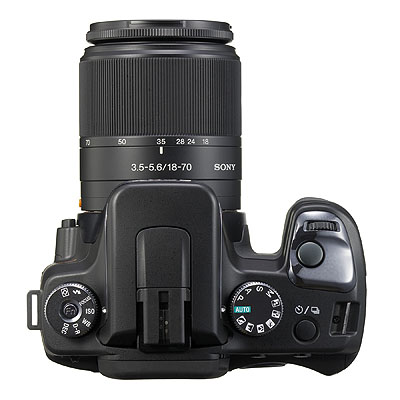
Sony Alpha 100 June 2006 launch report
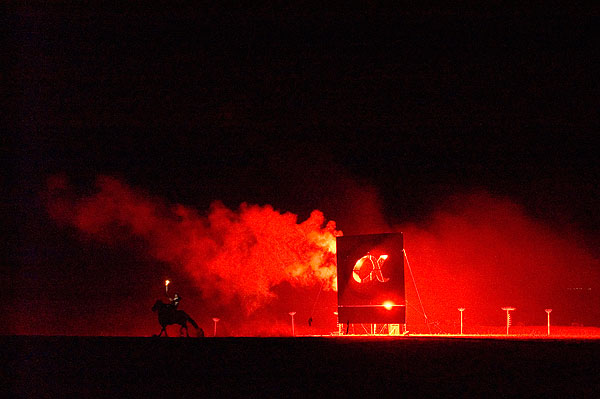
Shortly before the June 6th 2006 worldwide launch of the Sony Alpha digital SLR system the European press learned that major title editors would meet in Marrakesh for the unveiling of the Alpha 100. No-one anticipated being driven miles into the desert-like countryside of Oued Nfis for the experience of a night under canvas after witnessing feats of Berber horsemanship and a massive pyrotechnic intro! Read David Kilpatrick’s original report from the Summer 2006 edition of Photoworld magazine.

Many, indeed, didn’t have their cameras to hand when the show descended on fed and watered journalists, but I had fitted my 28mm ƒ2 lens to my 7D, set it for ISO 1600 and tungsten light, dialled minus two stops compensation and was ready to brave the dust-storm raised by the riders.
In between shots, the camera was wrapped in my hanky, well enough to stop the outside getting the good coating of sand which hair, clothes, and any remaining food quickly gathered.
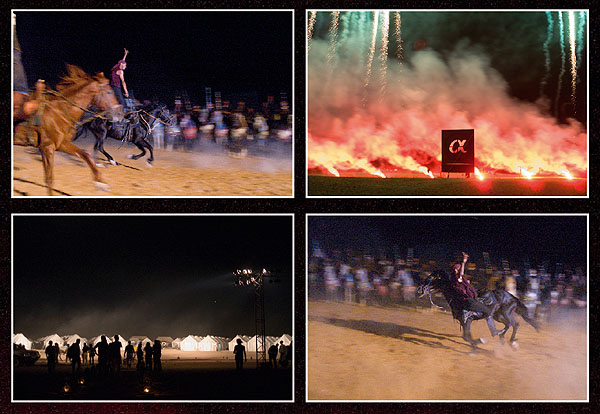
Everyone was worried about the dust. Dust is the bane of digital SLRs, getting on the sensor and requiring repeated cleaning procedures. Why had they brought us here for a DSLR launch? Morocco in June – dust, heat which is notoriously bad for CCD noise levels, burning overhead desert sun combining harsh contrast with flat subject-matter…
Alpha’s challenge

In the morning we learned why. The new Sony Alpha 100 has an anti-dust process which adapts the CCD movement used for the former Konica Minolta Anti-Shake, vibrating the assembly at high frequency every time the camera is switched off. Unlike cameras which use a similar process on switch-on, this does not increase start up delay.
The Alpha 100’s 10.2 megapixel CCD – possibly similar to one used in the D200 by Nikon, a company Sony admit they supply sensors to – also has a new anti-dust cover. The glass sheet covering the sensor itself serves as a UV/IR filter, an anti-aliasing filter, and now also has an indium tin oxide coating which reduces static and allows dust particles to be shaken free.
The next day, driven back into the foothills of the High Atlas to visit a Berber agrotourism centre with crafts and activities, the Alpha 100 bodies available for trial use were constantly being passed from hand to hand and lenses changed in the field. I was unable to find a single spot of sensor dust on any of my shots, and it seems that all the journalists had much the same experience.
If there was any disappointment, it was that we only used the cameras in daylight in our particular activity centre. Some other countries’ press groups visited the centre of Marrakesh and the souk, which affords plenty of low-light shooting. Thinking we might continue with evening shooting, I didn’t seek out the interior of the Berber tents for high ISO tests.
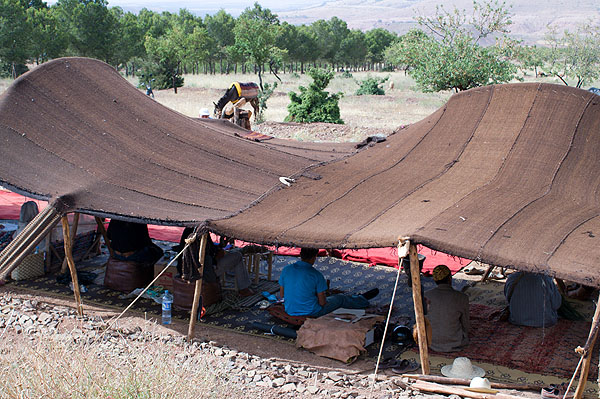
However, there was plenty of shade and the sun had some cloud cover. Hand-held shots to test the claims made for the improved version of Anti-Shake – Sony Super Steady Shot Inside – appear to have confirmed its effectiveness, because of over 70 shots taken, not a single one had visible camera shake blur.

In the shade of a heavy woollen canopy, with bright sun outside, this Berber woman was making rag rugs. The exposure for her rug along (shown later in this article) was 1/80th at ƒ4 with the 28mm ƒ2 lens at ISO 100. Outside the light demanded 1/1000th at ƒ4. The shot of her at work, taken without flash on Program setting, was given 1/200th at ƒ4 by the Alpha 100’s 40-zone metering system. The outside detail though overexposed by two stops has not burned out; this is the original in-camera JPEG, unmodified.
Motion blur of hands included in the shot, yes, but not a trace of photographer wobble. Sony claims 3.5 steps benefit for the improved SSS which literally adds a dimension to the former AS, responding with a more accurate compound compensation to mixtures of horizontal and vertical shake.
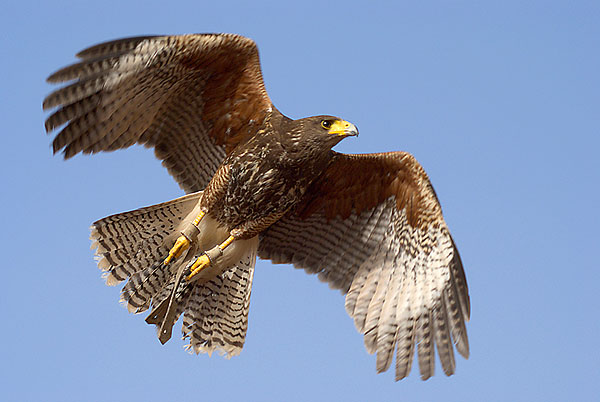
A lack of moving targets was tackled when a falconry demonstration started at the end of the afternoon. Fitting the new kit 75-300mm Æ’4.5-5.6 zoom (like the kit 18-70mm Æ’3.5-4.5 an updated and restyled verson of the Konica Minolta original) I grabbed a single shot as a hawk came directly towards me filling the entire frame.
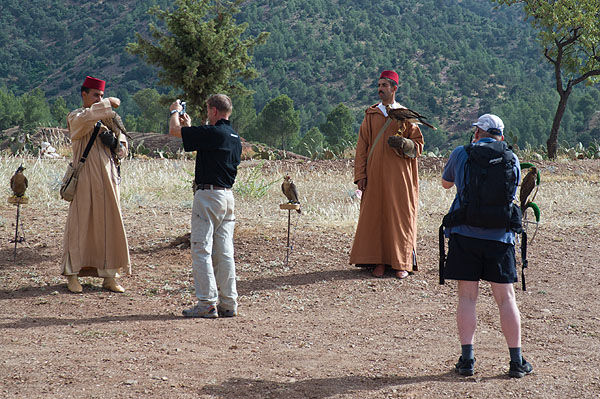
The photo press in action
This was on single frame advance and not on continuous focus as I had no time to change. The image was captured as sharply as anyone could possibly expect from a bird moving at that speed and angle relative to the camera. As I changed settings for the next flight, the demonstration ended… but a few shots following the handlers proved that even with the budget price tele zoom, AF is both fast and accurate on the Alpha 100. (Editor’s note – I had the benefit of using my Dynax 7D – some of the photo press, of course, had not come equipped with Alpha compatible bodies. One magazine even used the Sony Morocco trip to test a different camera make – and before running any information on the Alpha system, had run their review bootlegging on the Sony paid-for trip, for a rival brand. Amazing.)
Focus and sharpness
As Dynax 7D/5D owners, our critical questions are all about the AF speed and accuracy, metering consistency and above all the sharpness and image process quality of the Alpha 100. I had already tested the Nikon D200, known to have a similar 10.2 megapixel sensor, a few months earlier. My feelings were that I would not rush out to spend twice as much on that as our 5D, which offered a little less resolved detail from comparable optics but a bit more ‘snap’ to the colour and contrast.

But I was considering comparable optics not identical – and both moderately priced mid range zooms. Mounting top grade Minolta glass on my 7D and the A100, it was very clear that the A100 could extract finer detail effortlessly. Returning to base with the images, I had shot raw files (.ARW format) throughout, and Sony had the foresight to provide Adobe with advance information which meant I was able to process these using Adobe Camera Raw straight away.
Detail capturing capacity of the Alpha 100: this shot taken during the launch in Morocco, using a Minolta 100mm ƒ2.8 Soft Focus lens set to sharp focus and stopped down to ƒ8, has been processed from the raw .ARW file using Adobe Photoshop, and its colour and contrast enhanced to resemble a slide film like Velvia. You can view the original image, together with an unadjusted export and an in-camera JPEG and dozens of other Alpha 100 examples, by visiting – http://www.pbase.com/davidkilpatrick/alpha_100
The most careful shots, with the highest quality lenses, showed that the A100 has very accurately set-up focusing. Tiny errors are easily seen in a digital image of this size, and I could spot where the camera was clearly preferring foreground objects to background. The most common AF error – shooting two people with a space between them and ending up with the distant view sharp and the people blurred – seemed to be programmed out of the A100’s system. It picked the people, or person, every time.
The new exposure system has a staggering 40 metering zones instead of the familiar 14. Since this was a camera trial, I left the exposure to the camera to handle with a few adjustments to test what under or overexposed shots looked like. Again, exposure accuracy goes a step beyond the 7D and 5D – as you would expect, that’s progress.

A typical in-camera JPEG from the Morocco shoot – taken using the 11-18mm Konica Minolta zoom, which proved its true sharpness for the first time on the Alpha 100. The metering and dynamic range were excellent with good detail in shadows and highlights, and no post-processing required for this result.
There is more still. The Alpha 100’s new sensor and BIONZ processor (think ‘beyond’ – the French pronounced it best) combine to give a dynamic range compression well beyond any DSLR I’ve used. Even the Fuji FinePix Pro S3 with its additional set of sensors to capture highlight detail and the Kodak DCS Pro SLR with its ERI-JPEG format never did any better than this. It was possible to get highlight information in raw files to go beyond the safe range of unclipped full colour adjustment, but only in extreme circumstances. Judging subjectively, the Alpha 100 will show natural-looking detail in highlights at least one step brighter than the 7D or 5D while retaining full shadow information.
All such features have a trade-off, and in the Alpha 100, colour is a little more neutral than either the 7D or 5D. Technically it is more accurate, but if you are used to the saturation and warmth of the Konica Minolta ‘look’ you will find the Alpha 100 a little understated. When processing from raw, adjustments can make either type of colour look much as you want. JPEG shooters will probably be turning the colour to sRGB+ (vivid).
White balance is an issue I need to investigate, as the JPEGs all look great but Adobe Camera Raw reported some very low apparent Kelvin values for daylight shots. It is well known that ACR does not use the maker’s original White Balance information, and I think this is an error in ACR not the file format. We shall be looking at Sony’s own processing software, and other proprietary converters as they gain the ability to process .ARW files.
The bottom line is that the Alpha 100 produces pictures with accurate but fairly neutral colour, very high sharpness, considerable compression of subject contrast, and very low chromatic noise. At ISO 100 to 400, luminance noise increases gradually from invisible to just detectable; at ISO 800, there is some discernable chromatic noise added to the luminance pattern; at 1600 noise remains tight but definitely present, with more muted colours. You can see our noise tests from this shoot as shown below at full size here.
Compared to the 7D or 5D, I would say there is a more regular luminance noise (like well processed film grain) increasing in proportion to ISO; and a less prominent coloured noise, which only becomes strong at 1600. Random noise artefacts appear better controlled, but I’ll need to try night and low light shooting to see whether there is a hidden gain. In theory the 10 megapixel sensor can not be as noise-free as a 6 megapixel sensor. In practice I reckon both the in-camera processing, and typical raw conversion with image post-processing, will yield at least as good a 1600 ISO result from the Alpha. It does not offer 3200, but 3200 is a setting I disabled on my 7D after using it once accidentally for important shots. In emergencies just shoot at 1600 and underexpose by a stop… the end result is much the same!
DRO and DRO+
If this was the end of the story, the Alpha 100 would already be an ‘add to my shopping basket’ item for many 7D or 5D owners. But the Alpha has something even more valuable in store, called DRO (marked D-R on the camera’s function dial).
DRO ‘Standard’ uses the 40 metering cells to asses the contrast of the scene, and then selects from a range of 400,000 possible gamma curves to adjust shadows, highlights, midtones, black and white points. This process takes only 0.04 seconds and the camera is effectively as fast using DRO as without.
DRO+ is an entirely different process, provided by London software company Apical Ltd. I found it so interesting I visited Apical and talked to Dr Michael Tusch, their CEO.

Limited by non-disclosure agreements, we were able at least to confirm that DRO+ is unique to Sony though Apical Ltd has provided Nikon with a similar process called D-Lighting for certain consumer range compacts, and Olympus licences part of their raw conversion software from this R&D based imaging company.
The DRO+ software is resident in the Sony BIONZ processor, and Mike Tusch was full of praise for the power and speed of this processor. He said it was unlikely a similar function would appear in other DSLRs for some time, and that Sony had really achieved a feat by making it possible on a 10.2 megapixel image (the Apical information says the maximum limit would be a 16 megapixel image).
It takes half a second for the camera to analyse the captured image, comparing differences between pixels and their near and distant neighbours. From this, a map of areas of light and dark detail is created and the software applies local gamma curve changes without ever creating a hard boundary. It is as if the contrast and brightness are judged by a human eye, which automatically compensates and sees into shadows, without bright areas becoming glaring in the process.
DRO+ processes the raw data, not the image stored on the memory card, but it’s been very hard to get a consistent answer as to whether this happens between the CCD and the buffer or between the buffer and the card. This is probably the secret element. From what I have learned about the .ARW raw file format, it is more likely that the processing happens early on. The .ARW format divides the image into neat blocks of R, G and B data which don’t read out in a literal Bayer pattern order. This enables Sony to compress the data losslessly with maximum speed and effectiveness. The raw format is particularly fast to read for review on the large 2.5 inch rear screen which is as bright as the 5D and finer in detail than the 7D. The image appears almost instantly because of the way the blocks of data can be sampled.
The very powerful BIONZ processor is doing far more than many DSLR imaging engines. It will, for example, create High quality JPEGs from captures at a rate of 3 frames per second for an unlimited period – up to the capacity of the card (either CompactFlash, or the very affordable and fast MemoryStick DUO PRO used in a CompactFlash adaptor provided with the camera).
We will be looking in detail at Dynamic Range Optimisation and trying to find out more about the process. Sony state that it does not work on raw .ARW capture or RAW+JPEG, but in ignorance of this, I tested it in three modes (Off, Standard and Enhanced – Off, D-R and D-R+) without disabling raw shooting. Since there appeared to be significant shadow detail improvement in the raw shots and JPEGs alike, I assumed it was active. Mike Tusch told me it could optimise a raw file, and did not have to be just a JPEG, but that was entirely up to Sony’s implementation.
DRO+ promises some worthwhile enhancements to pictures which would be very poor without it. Excess contrast between lit and unlit areas, strong backlight and problems with white dresses and dark suits are all automatically tackled by DRO+.
The half-second process time does not slow the camera down, either; it just delays the overall start and end of writing a sequence of shots. The first shot won’t hit the memory card until half a second late, but the next shot follows just as fast as if DRO+ had been turned off.
This may explain why the Alpha 100 appears to have a smaller buffer memory than the Dynax 7D, and will only guarantee a series of three consecutive RAW+JPEG frames at 3 fps (slightly faster than the 7D’s 2.8 fps). I suspect the buffer memory has been partitioned, a kind of dual buffer, to allow for the intensive image processing and sequence writing.
Lens compatibility
But, to conclude this first report on the Alpha system, it’s important to cover all the questions which many internet correspondents have raised with me (and others).
First of all, the new Sony range of ‘normal’ lenses is nothing less than the original Minolta lens range – 16mm ƒ2.8, 20mm ƒ2.8, 28mm ƒ2.8, 50mm ƒ2.8 Macro, 100mm ƒ2.8 Macro, 50mm ƒ1.4, 500mm ƒ8 reflex, 135mm ƒ2.8 (T4.5) STF, 24-105mm, and 75-300mm all are full frame and fully compatible with M-AF (Alpha mount) SLRs back to 1985.
The top-drawer 35mm Æ’1.4 G (D) is equally compatible, but the 70-200mm Æ’2.8 SSM, 300mm Æ’2.8 SSM and apo tele-converters are only compatible with those Minolta and Konica Minolta models which were SSM capable.
The 11-18mm, 18-70mm and 18-200mm lenses are digital APS format only but again fully backward compatible with the Dynax 7D and 5D.

We do not have full details of the compatibility of the new Carl Zeiss lenses for Alpha – a Minolta G replacing 85mm ƒ1.4 Planar T* ZA; a full frame 24-70mm ƒ2.8 Vario-Sonnar T* ZA; an unexpected 135mm ƒ1.8 Sonnar T* ZA full frame; and a digital-only 16-80mm ƒ3.5-4.5 Vario-Sonnar DT ZA. Their backwards compatibility will depend on the type of focusing mechanism used, yet to be revealed.
Based on brief use of the 18-70mm and 75-300mm in Morocco, I can confirm that both these lenses appear to have been improved and it’s not mere cosmetics. The whole Alpha 100 focusing experience is faster and more positive and these lenses were already excellent designs optically. The barrels and zoom action have been firmed up a touch and the focusing resistance better matched to the camera.
As for future lens releases, we don’t know what they are but the gaps in the launch range for 2006 may indicate what to expect in 2007.
Flash compatibility
Older genuine Minolta Alpha mount lenses back to 1985 should all be fully compatible with the Alpha 100; third party makes may not be.
The new flash HVL-F56AM and HVL-F36AM units are essentially the 5600 and 3600 with new branding, and the flash shoe remains unchanged. However, you should not assume total compatibility. We expect the new models will be set up to function perfectly with the Alpha digital bodies, while the older Minolta and Konica Minolta models were a compromise designed to work with film or digital, often needing a calibration adjustment for good results on the 7D and 5D. This should not be the case with the new Sony models; we will have to find out whether they are also, as a result, improved performers on the Dynax digital bodies.
Sony has opted to continue not only the wireless system compatibility but also the cable system with off-camera shoe, cables, triple connector and so on. Again, until we have tested new models together with 5600 and 3600 HS (D) guns, full wireless interoperation can’t be confirmed but it looks as is cabled set-ups will be functional right back to the earliest similarly equipped flashguns. That, amazingly, goes back 25 years to include MD system items like the Auto Electroflash 360PX.
Sony’s own contribution to the range, their Ring Light HVL-RLAM, is not a flashgun at all but an LED continuous source ringlight, and as such is compatible with all cameras.
Battery and grip
There is no suggestion that we can expect a battery grip for the Alpha, since it is based on a 5D size body and no grip was ever made for the 5D. The handgrip of the Alpha 100 is an improvement over the 5D, with a little more forward heft and better finger space. The positioning of the shutter release button aids vertical holding, which tends to push your trigger finger inwards a touch.
A second reason given for wanting a grip – the first is usually ergonomics plain and simple, if not a love of big impressive camera kit – is battery power. The Sony Stamina NP-FM55H 1600 mAh battery is something between 50 and 100 per cent higher in shot capacity than the earlier Konica Minolta NP400 used in the 7D, 5D, A1 and A2. It is pretty much as good as having two batteries, from the start, offering about 750 shots with flash and many more without.
The Alpha 100 is not charged in normal Sony fashion using a mains adaptor which plugs into the camera, but in Minolta fashion with a separate battery charger. An optional twin-battery charger and mains adaptor can provide constant power for studio shooting, connection to a computer, PictBridge printing or sensor cleaning should that ever be needed.
The external AC-VQ900AM, which charges two cells in sequence (not simultaneously) also outputs AC to the camera, which the supplied single battery charger can not do. However, you had to add the cost of an AC mains adaptor with the 7D or 5D if you wanted to connect to printers or clean the sensor. I will probably fork out for an extra couple of cells and a twin charger, and for those who do not need such a massive shooting capacity, the battery life is such that no mains adaptor should be needed.
Memory Stick
There have been grumblings about MemoryStick storage cards – diehard CF users afraid Sony would make the camera MemoryStick and nowt else! Well, fear not, because it appears to be very fast CF card compatible and comes with a CF adaptor for MemoryStick Duo, not the old big sticks. The Duo or Pro Duo card is precisely the same size as the 1988 Creative Expansion Card format used by Minolta so you can dig out your old CE Card wallets and strap holders… they fit MS Duo cards perfectly. It is about the same size as an SD/MM card.
I decided to buy a card before going to Morocco, in case the camera did have only MemoryStick compatibility. To my surprise, a genuine Sony MemoryStick PRODuo 2 gigabyte card cost me £25 cheaper than the equivalent CF card by mail order, and when tested it proved to be about the same speed as an 80X CF card on our computer. However in the camera it appeared to be much faster – this also applied in a Sony DSC R-1 camera I was testing – leading me to think that Sony have optimised communications between camera and their own card format. High street prices can be higher, as I noticed at in the airport photo store. With Sony MemoryStick capacities, speeds and prices probably matching or beating the CF card format, getting the adaptor free is a welcome bonus. There is certainly no cause for grumbling, you can even use it in your 5D/7D.
To be continued
The Alpha 100 is an important camera for all Minolta system owners, because its success will determine the development of future lenses and accessories and their availability.
As 7D and 5D owners, we have the usual problem; we were happy with the quality from these cameras. Why upgrade? Answer – once you see the quality from the Alpha 100, especially if you have over 70 shots taken with it, a nagging dissatisfaction with the sharpness of 7D and 5D shots begins to set in. The 6 megapixel cameras produce a file 2000 x 3008 pixels yet this looks much less sharp at 100 per cent than a typical Alpha 100 shot 2595 x 3872 pixels at 100 per cent. It’s not just better at getting the shot in pinpoint focus, and correctly exposed, it processes the image for a more detailed result and the file is substantially larger.

A picture taken using the 28mm ƒ2 – see details earlier
The overall effect is a bit like moving up from 35mm to 6 x 4.5cm in terms of perceived overall image quality, provided your lenses are up to it. I used my 28mm ƒ2, 100mm ƒ2.8 SF, 24-105mm (D), 100-300mm APO (D) and 11-18mm plus the Sony 18-70mm and 75-300mm kit lenses. Every single lens performed well and my view of the 11-18mm as not being especially sharp was demolished – it may not be that sharp on the 7D, with the ultra-fine image detail a wide-angle naturally produces, but it was stunning on the Alpha 100.
I ordered my own Alpha 100 body only from Calumet the moment they listed their price (£585 inc VAT at the time). As most of you will know, I prefer to own my cameras and not to try to borrow them permanently from the distributors, despite running a magazine or two. I won’t turn down an official test camera and lenses, and hopefully will have two Alpha 100s to test simultaneously. This will help establish consistency (Editor’s note – all journalists attending the Morocco launch from the UK were told they would be sent an Alpha 100 kit to keep and use permanently, not just a loan camera. Most magazines do not own Alpha mount equipment and only have Canon and Nikon ‘house’ cameras or personal cameras. Whether other magazines received such a kit or not, I don’t know; we never did. Or a loan camera).
So, this is to be revisited. By the time we publish our Autumn edition – post-photokina, which means in October – more news of Alpha system developments should be available. We will have had time to examine and assess the Alpha 100 properly in direct comparison with the 7D and 5D. Like all 7D users, I am fully aware that it comes nowhere near matching the professional user interface of the 7D but in the end it’s image quality which counts for me. Moreover, I can not imagine a situation where Shirley and I are shooting and I’m using a camera which creates larger, sharper images than hers. What if she gets a shot which is definitely the best of a set? It happens now! If the Alpha 100 performs as I think it will, that’s two bodies to buy (Editor’s note – we continued with the 5D until July 2007, and then bought a second Alpha 100 – the price had fallen to the extent that even with a new model about to appear, a spare body seemed a very sensible idea. The cost of upgrading, after selling the 5D kit, was about £150 in real terms).
It does not worry me in the slightest. The cost of two Alphas is less than I paid for one 7D and that in turn is half what it used to cost me for film each year. Today, it’s your lens outfit which should be the permanent investment – new DSLR bodies, within reason, replace older ones as technology advances.
– David Kilpatrick


Leave a comment
You must be logged in to post a comment.